You do not need to flatten an EV battery to find out roughly how far the car is capable of travelling.
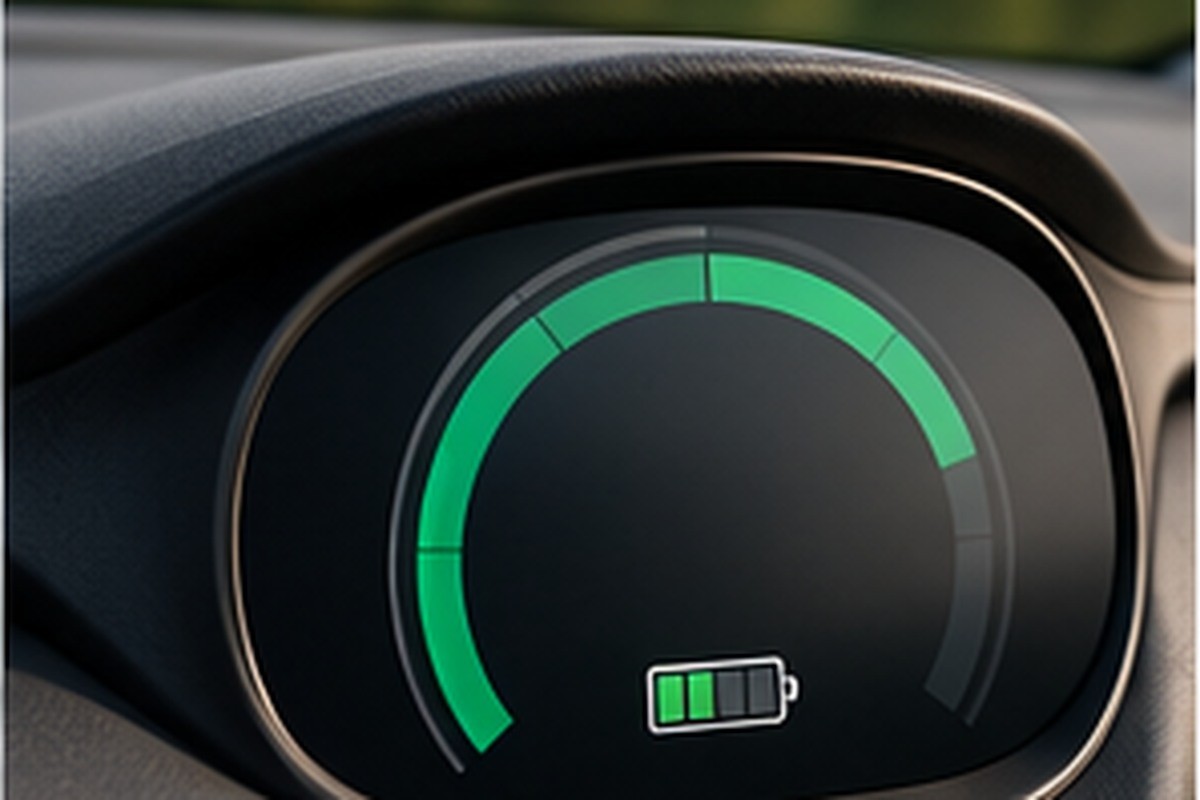
A normal journey can give a useful figure as long as enough of the battery is used.
The basic information is simple:
- distance driven;
- battery percentage at the start;
- battery percentage at the end.
MyEVRange uses those three numbers to calculate the equivalent full-battery range.
An example
You leave home at 90% and arrive with 30% remaining.
That means you used 60% of the battery.
If you travelled 162 miles, the equivalent range for 100% of the battery is about 270 miles.
You did not need to start at 100%, and you did not need to risk arriving somewhere at 0%.
Why we do not ask owners to type their range
Modern EV dashboards estimate remaining range using recent driving, temperature and other information. The number can be useful, but it is still an estimate.
If we simply asked every owner “what range does your car get?”, we would end up mixing dashboard guesses, memories, best-ever journeys and genuine measured trips.
Distance plus battery used gives us a more consistent starting point.
Why tiny journeys are not very useful
If you drive ten miles and the battery display falls from 80% to 78%, that two-percentage-point change is too small to extrapolate confidently.
Battery displays are rounded, and a one-point difference can have a huge effect when the total change is tiny.
For that reason MyEVRange requires a minimum battery drop before a journey can count.
Longer journeys that use a meaningful chunk of the battery tell us much more.
It is still an estimate
Even a well-measured journey is not a laboratory test.
The battery percentage shown by the car is rounded. The route may climb or descend. Wind, temperature, traffic and cabin heating all affect the result.
That is exactly why a single journey is not treated as “the range” of a model.
The value comes from combining lots of journeys from different drivers.
Why one frequent driver does not get hundreds of votes
Some owners will contribute once. Others may submit dozens of journeys.
If every journey counted equally, one enthusiastic owner could heavily influence the average for an unpopular model.
MyEVRange therefore works out each contributor's average first, then uses those driver-level figures to build the model average.
More journeys from the same person still improve the quality of that person's result, but they do not turn one driver into fifty drivers.
Add a journey
If you own an EV, find the exact model and variant in Browse EVs, then enter a journey when you have used a decent amount of the battery.
It takes less than a minute and makes the next buyer's research a little more useful.